

Sanitary Valve Selection Guide for Food and Beverage Processing
Comprehensive Usage Recommendations, Installation Guidelines, and Operating Procedures
Sanitary valves play an essential role in maintaining hygiene, ensuring product purity, and supporting efficient flow control in food and beverage manufacturing. Selecting the right sanitary valve directly affects product quality, production efficiency, and compliance with global safety standards. This guide provides a professional, SEO-optimized overview of sanitary valve selection, installation, usage steps, and operational recommendations tailored for dairy, brewing, beverage, bakery, condiments, and food processing industries.
Sanitary valves are specially designed flow-control devices used in hygienic pipelines where contamination-free transfer is essential. These valves are manufactured using food-grade materials such as 304 or 316L stainless steel, polished to a hygienic surface finish, and equipped with seals suitable for regular cleaning cycles.
Sanitary valves support critical functions such as fluid regulation, product transfer, CIP/SIP cleaning, mixing, batching, filtration, and filling operations. Their design minimizes bacteria accumulation, dead zones, and cross-contamination. Because the food and beverage industry must comply with strict quality and safety regulations, choosing the right sanitary valve is fundamental to achieving high-standard production.
Choosing the appropriate sanitary valve involves evaluating application needs, operational conditions, and hygiene requirements. Below are the core selection factors.
Different processes require different valve designs:
| Valve Type | Best For | Key Advantages |
|---|---|---|
| Sanitary Ball Valve | On/off control, viscous liquids | High flow, minimal pressure drop |
| Sanitary Butterfly Valve | Large pipe diameters, cost-effective flow control | Lightweight, easy to install |
| Sanitary Diaphragm Valve | Sterile applications, pharmaceuticals, low-particle processes | Zero dead-space, excellent CIP/SIP compatibility |
| Sanitary Check Valve | Backflow prevention | Protects pumps and systems |
| Sanitary Pressure Relief Valve | Overpressure protection | Automatic release for safety |
316L stainless steel preferred for corrosive liquids, acidic juices, carbonated beverages.
304 SS suitable for general food applications.
Surface roughness: Ra ≤ 0.8 μm for hygienic performance.
Internal polishing improves cleanability.
Select seals compatible with product type and cleaning chemicals:
EPDM – excellent heat resistance
PTFE – chemical resistant
Viton – suitable for oils and fats
Silicone – ideal for lower temperatures
Ensure valves comply with:
3A Sanitary Standard
FDA Food-Contact Regulation
EHEDG Hygienic Design Guidelines
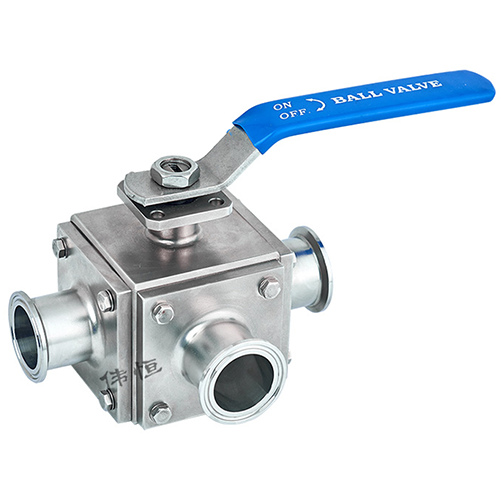
The following recommendations help maintain performance, hygiene, and service life.
Use ball valves for thick sauces, syrups, and yogurt.
Use butterfly valves for water, juice, and low-viscosity beverages.
Use diaphragm valves for sterile or aseptic products like milk or infant formula.
Choose hygienic designs with:
Minimal crevices
Smooth internal flow paths
Fully polished surfaces
This prevents microbial growth and ensures quicker cleaning cycles.
Ensure seals are compatible with:
Cleaning chemicals
Steam temperatures during SIP
The product’s pH and viscosity
Routine tasks include:
Visual inspection
Seal lubrication
Actuator calibration
Torque adjustment
CIP/SIP verification
Proper installation is critical for hygienic performance and pipeline reliability. Incorrect installation can lead to leaking, contamination, and inefficient flow.
Before installing any sanitary valve, check the following:
The valve model matches the pipeline specifications
All components are cleaned and sanitized
The pipeline is depressurized and isolated
Sealing gaskets are present and in good condition
The flow direction marking is identified (for check valves and control valves)
Stainless steel spanner
Torque wrench
Clamp fittings
Tri-clover connections
Hygienic sealing gaskets
Clean working area
Dry and dust-free installation zone
Adequate lighting for visual inspection
The following procedure applies to most sanitary valve types, including ball valves, butterfly valves, and diaphragm valves.
Check the label or arrow indicating flow direction. Align the valve properly to maintain correct operation, especially for check valves and control valves.
Place food-grade gaskets between the valve and pipeline connections. Ensure the gasket is centered to prevent leakage.
Secure the valve using tri-clamp connectors or welded ends, depending on your pipeline design. Do not overtighten to avoid damaging the clamp or gasket.
Using a torque wrench, tighten bolts or fittings according to manufacturer instructions. Excessive torque can deform stainless steel or cause seal leakage.
For pneumatic or electric-operated sanitary valves:
Connect the air supply
Mount the actuator
Check position sensors
Verify open/close signals
After installation:
Pressurize the system
Inspect all joints and gaskets
Check for audible leaks
Conduct a quick functional test
Before initial use, perform:
CIP cleaning cycle (alkaline wash + acid wash)
SIP steam sterilization if required
Proper operation ensures stable performance and long-term reliability.
Manual valves (ball, butterfly) must be opened and closed slowly to avoid water hammer.
Automated valves should be monitored for actuator response time.
Use ball valves for quick on/off flow.
Use diaphragm valves or control valves for precise flow adjustments.
Avoid throttling with butterfly valves for high-pressure applications to prevent excessive wear.
During cleaning:
Maintain proper cleaning fluid temperature and concentration
Confirm seals are compatible with CIP chemicals
Avoid sudden temperature shocks to prevent seal deformation
Do not operate valves without cleaning fluid during CIP
Avoid using incompatible lubricants
Do not expose valves to excessive vibration or pressure
Do not use damaged seals
Below are common issues and their recommended solutions.
| Problem | Possible Cause | Solution |
|---|---|---|
| Leakage at connection | Loose clamps or worn gaskets | Tighten clamps or replace gasket |
| Valve sticking | Product buildup or improper cleaning | Perform CIP; inspect seals |
| Poor flow control | Incorrect valve choice | Switch to a more suitable valve type |
| Actuator failure | Air supply issue or sensor misalignment | Check air pressure; recalibrate sensors |
To extend valve lifespan:
Perform regular inspections (weekly/monthly)
Replace sealing components annually or as required
Maintain proper lubrication according to manufacturer guidelines
Record maintenance logs
Ensure CIP/SIP cycles follow validated parameters
Selecting, installing, and operating sanitary valves correctly is essential for maintaining hygiene, improving production efficiency, and ensuring compliance in food and beverage processing environments. By following the detailed selection criteria, installation steps, and operating guidelines in this guide, manufacturers can significantly reduce contamination risks, improve product consistency, and extend valve service life.
This comprehensive sanitary valve selection guide is suitable for food processors, beverage factories, dairies, breweries, and any facility seeking reliable hygienic fluid control solutions.
Tel: +86 577 8699 9257
Tel: +86 135 8786 5766 /+86 137 32079372
E-posta: wzweiheng@163.com
Adres: Hayır. 1633, Yidaoba Yolu, Binhai Endüstri Parkı, Wenzhou Şehri, Zhejiang Eyaleti

Wechat'i tarayın
Bu web sitesi, web sitemizde en iyi deneyimi yaşamanızı sağlamak için çerezleri kullanır.
 English
 Español
 Portugues
 Pусский
 Français
 Deutsch
 한국어
한국어 العربية
 Italiano
 ไทย
ไทย हिन्दी
 Melayu
 Tiếng Việt
 dansk
dansk қазақ
қазақ বাংলা
বাংলা українська
 Filipino
 o'zbek



 Telefon
Yorum
(0)